

Written by Dr. Gabrielle Anderson, O.D., and Drew Caldwell, Founder of OjO Recruitment Agency · Updated October 16, 2026
Search OjO’s Optometrist Jobs
Summary: Navigating Residency-Trained Optometry Careers
This guide covers career pathways, employment models, job fit evaluation, and compensation for residency-trained optometrists (ODs) seeking medical-model practices and long-term advancement.
Key Takeaways
- Evaluating Practice Fit: Key criteria for finding clinical autonomy, modern diagnostic technology, aligned practice culture, and long-term mentorship.
- High-Scope Job Opportunities: Roles in co-management, ocular disease, cornea/scleral lenses, other OD specialties that fully utilize advanced residency training.
- Partnership & Equity Models: Pathways from associate positions to buy-ins, practice ownership, and profit-sharing structures.
- Compensation & Benchmarks: Typical salary ranges, production-based bonus models (collections vs. production), and PTO.
Finding the Right Practice Fit After Residency
As a residency trained optometrist you are dedicated, disciplined, hardworking and highly motivated. You’ve proven this by investing an extra year in learning, caring for patients, and becoming a more confident optometrist. Choosing your first job after residency deserves an investment of a different sort: taking the time to think about what you want from your work and the life around it. You’ll want to find a role with a practice where you can use what you’ve learned, contribute to the organization and its care for patients, enjoy your work, and continue to grow.
You also have something very valuable to offer practices. Your residency has given you focused clinical experience, and you’ve worked hard to develop your skills and judgment. Although you’ll continue learning throughout your career, you can enter your job search with confidence in your training and what it has prepared you to contribute. Look for colleagues who recognize and value those strengths and will help you build on them.
Maybe caring for patients with ocular disease is what you’ve come to love. Perhaps it’s cornea work—the satisfaction of a challenging specialty lens fit. Maybe it’s pediatric care, where you’re helping a child see better, or low vision care, where you’re helping seniors make the most of their remaining vision. Along the way, you may also have discovered how much you enjoy teaching or talking through difficult cases and complex pathologies with ophthalmology colleagues.
Those experiences can help you think about what comes next. What would you love to spend your week doing? Who would you like to learn from? And where could you see yourself building a life and a career?
You don’t need to have your whole future figured out. We wrote this guide to help you explore your options and get a clearer sense of what you want in your first employment opportunity.
For more information about the employment outlook for residency trained ODs, read Why More Ophthalmology Practices Are Hiring Medical Optometrists
Decisions, Decisions: What Would Make You Glad You Chose This Practice?
Imagine you’re a year into your new position. A friend asks how work is going, and you say, “I’m really glad I came here. It’s a great fit for me.”
What would make you say that?
Perhaps you’ve found a mentor who takes an interest in you as a person and a doctor. Perhaps you’re providing care that patients in the community have needed for years. Or perhaps the work and schedule fit your life better than you had hoped.
Your answer gives your search a direction that salary and location alone can’t provide.
During residency, you’ve been learning about yourself, too: the work that holds your attention, the people you enjoy learning from, and what makes a demanding day worthwhile.
At OjO, we’ve helped countless optometrists think through these decisions. Finding an available job is usually easier than figuring out which one you’ll be glad you accepted. That takes conversation, curiosity, and an honest look at what matters to you.
Let’s start there.
Work, Life, and Everything in Between
For many residency-trained ODs, part of the pleasure of medical eye care is working through a complicated problem. You study the findings, consider the possibilities, and talk with a colleague who sees something from another angle.
Working alongside surgeons and fellowship-trained ophthalmologists can make clinic a place you’re excited to be. A difficult case sparks a conversation, a physician notices a finding you hadn’t considered, and you have an insight of your own to offer. You’re contributing, learning, and collaborating with doctors who share your enthusiasm for the work.
Those experiences can help you picture what you’d like to build over time. Perhaps you enjoy teaching and would love to work with students or residents. Perhaps the satisfaction comes from following patients for years and getting to know their families. For some young doctors, ownership may be appealing—the chance to help shape a practice’s future. Or you may prefer to concentrate on patient care and let someone else handle the business responsibilities and staffing headaches.
Alongside those hopes, consider the rhythm of your week. After the demands of training, four or five days—with no nights, weekends, or call—might sound especially attractive.
Your priorities don’t have to look like anyone else’s. Think about what you’ve enjoyed and the kind of week you would look forward to.
What career paths are available after an optometry residency?
Many. The short answer is you’ll have a lot of great career options. Your residency may have helped you discover a particular interest. It may also have shown you how much you enjoy variety. Both are useful things to know as you begin the process of identifying a wonderful opportunity.
An ocular disease residency graduate might want a schedule devoted to disease management, urgent visits, and surgical co-management. Another doctor with the same training might prefer a position with a healthy mix of primary and medical optometry patients.
In our recruiting work at OjO, we’ve seen how much ophthalmology groups value residency training that prepares ODs for medical eye care. These doctors become respected colleagues, managing ongoing eye conditions and caring for patients before and after surgery. Their contribution helps patients receive consistent care and gives surgeons more time to focus on those who need surgical treatment.
There are opportunities beyond ophthalmology groups, too. The table below offers a starting point.
| If you enjoy… | Settings worth exploring | A useful question to ask |
| Ocular disease and surgical co-management | Ophthalmology groups, referral centers, VA facilities | Which conditions would I manage, and how would care be shared? |
| Specialty contact lenses and corneal care | Specialty lens clinics, ophthalmology groups with cornea surgeons, full-scope private practices | Are referrals established, and what fitting equipment and support are available? |
| Pediatric eye care | Pediatric optometry practices, children’s clinics, academic programs, ophthalmology groups with pediatric services | What ages and conditions would I see? |
| Low vision care | Low vision clinics, rehabilitation programs, VA facilities, academic centers | What resources help patients beyond the examination? |
| Teaching | Schools of optometry, academic clinics, practices that host students or residents | Whom would I teach, and how much time would be devoted to it? |
| Varied care and long-term patient relationships | Ophthalmology groups, Full-scope OD-owned practices, community clinics | How does the schedule balance comprehensive and medical care? |
These categories overlap. You might teach OD students or medical students in a private practice, fit specialty lenses in an ophthalmology group, or provide extensive disease management in an OD-only office. Dig into the details beyond the job title.
For more information on this topic, read Your First Optometry Job: Insightful Guidance for New ODs Entering the Profession and How to Find the Right Optometry Job (Not Just Any Job). AKA “Cheez-Its & Choices.”
Your Contributions: Where Could Your Help Make a Difference?
As you weigh opportunities, start with a fundamental question: “Why is the practice hiring?”
Perhaps patients are waiting months for appointments, and some are choosing a competing practice across town where they can be seen sooner. Perhaps a longtime optometrist is retiring, leaving patients who need someone to continue their care. Or the group may be in growth mode and wants to introduce a service you could help develop.
If ocular disease is the path you want to pursue, listen for where that need meets your interests. A group may want an OD to follow patients with glaucoma, diabetic eye disease, or other chronic conditions, see urgent medical complaints, and work alongside surgeons.
Discuss how care would be shared. Understanding which patients you would manage, when you would consult an ophthalmologist, and whether you could follow patients over time helps you picture the clinical role.
If patients are already waiting, I’d want to hear how the group plans to introduce you and get your schedule going. If you’re being invited to build something, I’d spend more time discussing the support you’ll have with marketing and community introductions.
A specialty lens service, for example, can be a wonderful opportunity to put your training to work. Talk about how you could develop it together, from building referral relationships to arranging patient instruction and follow-up. The equipment, staff support, and appointment time available will help you picture how it could take shape.
You may think, “I’d love to take this on.” Or a conversation with peers and preceptors may help you realize you would rather join an established service for now.
Before leaving the discussion, ask someone to walk you through a likely week. “Medical optometry” can mean different things in different offices. Understanding the balance of comprehensive examinations, disease management, urgent visits, and surgical co-management turns an appealing description into a job you can picture.
The Fit: Could You Feel at Home With These Physicians?
Some of the happiest ODs we hear from work in clinics where ophthalmologists trust their training, experience, and value their clinical judgment. They have a meaningful voice in patient care and the autonomy to put their judgment into practice.
Listen to how the surgeons describe the OD’s role, then spend time with the optometrists in the group. What do they enjoy? Do they feel comfortable offering an opinion? Are they included in decisions that affect their work?
You can also ask whether it would be possible to speak with the current optometrists on staff and also former OD employees. Consider that perspective alongside what current colleagues tell you and what you observe yourself.
If you can spend time in clinic, take the opportunity. Meet the technicians and administrative staff. Notice how people speak to one another when the day gets busy or someone needs help.
“We treat patients like family” is a lovely sentiment. You’ll learn more when you see how that ethos shapes an ordinary afternoon—when a patient needs extra time, has difficulty affording treatment, or needs another opinion.
A practice begins to feel like home when you share its values, believe in its approach to patient care, and feel respected. Those qualities matter long after the excitement of starting a new job has passed.
Mentorship: You’re Allowed to Keep Asking Questions
Finishing residency doesn’t mean you’ve finished needing guidance. As you consider where to begin your career, give real thought to who you’ll have the opportunity to learn from. The right mentor can shape the doctor you become and influence the course of your entire career. An experienced colleague who welcomes your questions, eagerly talks through difficult cases, and takes an interest in your development can help you build confidence, strengthen your clinical judgment, and discover interests you’ll pursue for years to come.
Dr. Gabrielle Anderson, coauthor of this article, encourages ODs to ask prospective employers this simple question: “Are you open to mentorship and questions that I may have?” It’s a straightforward question, she explains, and you should expect a straightforward response.
Practices that take pride in teaching and professional development will often welcome that conversation. Asking about mentorship shows that you value learning, recognize there is more to discover, and want to keep improving the care you provide. That combination of confidence, humility, and curiosity can say a great deal about the colleague you’ll be.
Even with strong training, you’ll encounter clinical findings you haven’t seen before. You’ll also be learning a new practice’s protocols and ways of working. It helps to know there is someone you can turn to without feeling embarrassed that “you should already know this.”
An experienced colleague who says, “My door is always open,” is an enormously valuable resource. Setting aside regular time together gives you room to review cases, benefit from their insights and guidance, and revisit a patient’s progress without trying to fit every conversation between appointments.
Ask who would mentor you, how questions are handled during clinic, and how regular meetings would fit into your schedules. For a doctor who enjoys talking through cases and learning from colleagues, these conversations can become one of your favorite parts of the week.
A Thoughtful Start to Your Patient Schedule
Patient volume is another conversation you should be able to have honestly.
In our experience, good, reputable practices care about helping new doctors become comfortable and efficient at a safe, manageable pace. They understand that the transition matters for patients, too.
Talk about your first six months and how the schedule would grow. How many patients would you see initially, and what would you be expected to ramp up to? Ask about the mix of comprehensive eye exams, urgent visits, disease management, and postoperative care in a typical day. A schedule template means more when you understand the complexity of the visits, the testing involved, and the technician support available.
Be candid about where you’re confident and where more time or help would be useful. These conversations help you and the practice plan a thoughtful start, with the time and support you need to care for patients well.
Help Them See the Value You Bring to the Practice
One piece of advice we often share with young doctors preparing for interviews is simple: lead with what you can contribute.
We’ve seen promising candidates spend so much of an interview discussing what they want that the group never gets a clear picture of what they have to offer. Give prospective colleagues a chance to appreciate your strengths and understand what you could bring to their practice.
Your preferences about compensation, schedule, location, and clinical responsibilities matter, and they deserve a full conversation. First, though, help prospective colleagues understand your training, work ethic, and reasons for wanting to join their practice.
Share why you chose to pursue residency training. What drew you to that area of care, and what did you discover along the way? Talk about the patients you enjoy caring for and what residency has prepared you to do well. As you learn where the group needs help, explain how your skills and interests could meet those needs.
Sharing a case you learned from can bring that conversation to life. Walk them through what made it difficult, how you approached it, and when you sought another opinion. Those details show how you think, how you learn, and how you might work alongside them.
We discuss this further in Want to Land Your Dream Optometry Job? Lead with the Value You’ll Bring, Not Just Questions About Pay.
Interview Preparation: Help Them See You at Your Best
If I could offer one piece of old-fashioned advice before your first phone call, Zoom conversation, or on-site interview, it would be this: Prepare. Don’t walk into an interview cold. Learn about the practice and the doctors you’ll be meeting.
Here’s a great real world example of how proper preparation can mean the difference between getting the job of your dreams or losing out. One OD we worked with was still completing residency when she earned a prestigious position with a nationally known ophthalmology group in a popular city. Several experienced ODs were also being considered, but she was offered the job.
What helped her stand out? How did she, as a new grad OD, win out over qualified, experienced providers? She prepared thoroughly…And then she prepared some more.
She read the surgeons’ practice biographies, studied their LinkedIn profiles, and reviewed their published research. She arrived with thoughtful, informed questions and followed up promptly after her visit.
Her preparation gave the group a glimpse of the colleague she could become: curious, motivated, and willing to put in the effort. She had taken time to understand their work and could have a meaningful conversation about joining them.
You can do the same. If something in a doctor’s clinical work or research interests you, spend a little more time with it. Let that curiosity shape your questions.
Come to the visit with questions- thoughtful questions. You don’t need years of experience to show that you come prepared and take an opportunity seriously.
What We’re Seeing in Offers to New Residency-Trained ODs
Compensation is understandably on your mind, especially if you’re carrying substantial student debt.
Here’s some context from the offers we’ve seen over the last two recruitment seasons:
| Offer component | What we’ve typically seen |
|---|---|
| Base salary | Approximately 90% of positions fall between $135,000 and $190,000 |
| Most common base-salary range | Approximately 80% of candidates receive offers between $145,000 and $175,000 |
| Signing bonus | Usually $5,000–$20,000 |
| Relocation | Often reimbursed separately; sometimes included in a combined signing and relocation allowance |
| Paid time off | Generally 2–4 weeks: most ODs we work with receive 3–4 weeks |
| Continuing education | A few additional days or reimbursement for CME |
These are observations from OjO’s recruiting work with new residency-trained ODs, shared in October 2026, rather than findings from a national salary survey. These figures describe base salary and selected benefits, not total earnings. Compare the workweek and responsibilities attached to each offer.
Consider the Big Picture: Starting Salary, Total Income, and Long-Term Fit
OD student debt is a big deal. When you have education loans to repay, the highest salary gets your attention. Of course it does. A generous signing bonus can feel especially welcome after years of training. Over time, though, the work you do and the people beside you will have a great deal to do with whether you want to stay.
An offer below the ranges above can still be an excellent opportunity. A solid role with a respected team deserves consideration, even if the starting salary doesn’t stand out.
We see practices with fairly ordinary base salaries and very good productivity arrangements. With a busy schedule, capable staff, and time to get established, you may be able to earn considerably more than the base salary suggests.
Sit down with the practice and work through a realistic example. Discuss the bonus threshold and calculation, optical bonuses, which services count, when it is paid, and what you could reasonably expect during your first or second year of employment.
If a fellow resident receives a higher offer, try not to let that number make the decision for you. You may be comparing different workweeks, responsibilities, benefits, and places to live.
You want to feel good about the financial arrangement. You also want to feel good about going to work there once the signing bonus has been spent.
Partnership: What Would You Like to Build Over Time?
Some opportunities deserve a closer look because of what they could become. A starting salary may not catch your attention, but the chance to help shape a practice and eventually own part of it might.
If ownership interests you, spend time understanding what “partnership opportunity” means in that particular group.
It helps to hear how the process has worked for other ODs: what they purchased, when they became eligible, how the price was determined, and what responsibilities came with ownership. You’ll also want to understand the voice partners have in practice decisions.
If you will be the first OD partner, learn what has been decided and what still needs discussion. A possibility is easier to evaluate when you know the steps involved.
You may be eager for ownership or prefer a few years of clinical experience first. You can also have a satisfying career as an employed doctor. Think about whether the responsibilities appeal to you alongside the potential rewards.
Before committing to a buy-in, have an attorney and accountant with relevant practice experience review the terms.
Teaching: Sharing What You’ve Learned
If you enjoyed helping students work through a finding during residency, teaching may deserve a place in your career.
Academic positions can combine clinical supervision, classroom instruction, research, and administrative work. Get a clear picture of how your time would be divided, what scholarly work would be expected, and what guidance you would receive as a new teacher.
Practices that host students or residents may offer another way to make teaching part of your week. Helping someone else develop their judgment can add another layer of satisfaction to your own clinical work.
Clinical Procedures: Be Specific About Your Interests
If you want particular procedures to be part of your work, discuss them by name. State permission alone doesn’t tell you whether “doing lasers” will be part of the position.
Confirm current requirements with the relevant state optometry board, then discuss the qualifications, equipment, staffing, and patient demand at the practice. Residency training alone does not authorize additional procedures.
Read the Agreement With Your Future in Mind
When you’re excited about joining a practice, it’s natural to picture yourself staying long-term. Still, take time to understand what the agreement would mean if your circumstances changed.
One detail worth discussing with your attorney is the geographic reach of any noncompete or restrictive covenant. If you’ll mainly work at one or two offices, does the language refer to those locations—or to eight or twelve satellites across a much larger area?
Ask your attorney whether the restriction can be limited to the locations where you’ll regularly work, rather than every office your employer owns. The distance covered matters, too. The goal is to preserve reasonable options for finding another position in the region if you need to leave, especially if your family has put down roots.
Have your attorney explain how the language would apply to your situation under applicable state law and what changes would be worth negotiating.
Think about other changes you may welcome, too. What maternity or paternity leave is available? Is it paid or unpaid, and how does it relate to your other time off? Understand the practice’s policies alongside the agreement.
If you eventually decide to leave, how much notice must you give? The review should also cover compensation terms, termination provisions, and any repayment obligations attached to signing or relocation payments.
These are considerations we’ve gathered through years of conversations with doctors about their employment agreements. We share them to help you ask thoughtful questions, and they shouldn’t be taken as legal advice. We always encourage you to work with an attorney familiar with optometrist employment agreements and applicable state law, so you understand the terms before you commit.
Leave Room for an Opportunity to Surprise You
For many residency-trained ODs, the job search naturally begins with geography—staying close to family, returning home, or moving to a favorite city. Start by deciding whether location is a firm requirement or an area where you have some flexibility.
Dr. Anderson encourages first-time job seekers to “be as open minded as you can be on things that aren’t deal breakers for you.” An opportunity doesn’t have to match everything you initially pictured to be worth a conversation. The right clinical fit, mentorship, or opportunities to grow may draw you to a community you hadn’t considered—and eventually come to love.
We’ve worked with doctors who chose rural communities over popular metro areas because they wanted to care for patients with few local options for eye care. The more they learned about the need, the more appealing the work became. Making a substantial difference and caring for grateful patients mattered enough to reconsider their original location preferences.
Another OD began her search hoping to join an OD-only group. Her interviews introduced her to a combined ophthalmology and optometry practice she hadn’t initially pictured for herself. After reflecting on the doctors she’d met and the work they shared, she realized that working alongside ophthalmologists would offer the clinical challenge and continued learning she wanted for the years ahead.
And one young optometrist wanted laser and minor procedures to be part of her work, within the scope permitted by her license and qualifications. She chose a position in Oklahoma, far from family and friends, because it offered the chance to pursue that interest.
You may finish your search with the same priorities you started with. You may also discover something you hadn’t known to look for. Keep what matters most in mind, and be willing to have a conversation about a practice that catches your interest—even if it falls outside your original plans.
How Long Should Your Job Search Take?
Start the conversation early in residency. Doing so leaves room for interviews, site visits, contract review, and credentialing without making every decision feel rushed or pressured.
We recommend beginning your search 6 to 9 months before your intended start date. If you’re targeting a highly competitive metro area, or you have narrow clinical preferences, start even earlier.
When you’re weighing your final options, picture an ordinary week at each practice. Would you enjoy the patients and the pace? Could you comfortably ask a colleague for a second opinion on a complex case? Would the schedule leave real time for family, friends, and the things that help you recharge?
Your first position doesn’t have to answer every question about the rest of your career. Look for worthwhile work, colleagues you respect, and a place where you can give patients great care while you keep growing.
Frequently Asked Questions About Jobs After Optometry Residency
Does residency training help new graduates get medical optometry jobs?
Yes. Your residency training can be a real asset as you look for a medical optometry position, especially in competitive metropolitan areas or larger ophthalmology groups where you’d work alongside fellowship-trained surgeons. Some practices require residency training; others prefer it but of course welcome doctors with substantial experience in medical eye care.
In our recruiting work, it can be especially helpful when a young OD hopes to join an established ophthalmology group in a sought-after location. Your training gives you experience to discuss and shows that you chose to spend additional time developing your clinical skills. It also proves that you’re dedicated, hardworking and motivated– all traits that employers value.
During interviews, explain what you actually did. Which patients did you care for? What conditions did you manage? How did your responsibilities grow? Share a challenging case, describe your reasoning, and explain what you learned. That preparation matters. So do your communication, relationships with patients and colleagues, and willingness to keep learning.
An ocular disease residency can provide concentrated experience with medical eye care, complex disease and pathology, diagnostic testing, acute complaints, and surgical co-management, depending on the program. Repeated encounters and feedback help develop clinical judgment about when to treat, follow closely, consult a colleague OD or ophthalmologist, or refer out to a subspecialist.
How can I tell whether a job will use my residency training?
Ask the practice to describe your likely patient mix and responsibilities – “What does a typical Tuesday look like in clinic?” A “medical optometry” position can mean very different things from one office to another.
Start with: “Could you walk me through a typical week for the doctor you hire?”
Listen for the balance of comprehensive examinations, disease management, urgent visits, and preoperative and postoperative care. Ask about appointment lengths, technician support, and diagnostic equipment and how closely will you be working with ophthalmologists in the organization. The schedule should give you time and help appropriate to the patients you would see.
Then find out whether those patients are already there. Joining an established specialty service is different from building one. If you hope to develop a specialty lens or dry eye service, ask where referrals will come from, what resources are available, and how the practice will support you while the schedule grows.
Be honest about comprehensive care. Some doctors enjoy the variety it provides while others want a more concentrated specialty role. It is better to discuss that preference before accepting a position than to discover a mismatch after you arrive.
What should I look for in MD/OD collaboration and mentorship?
Look for clear responsibilities, respect for your clinical judgment, and colleagues you can turn to when a patient needs another opinion. Having subspecialists within the group is a tremendous benefit—both for your patients and for your own growth. Those conversations offer opportunities to learn from one another, work through challenging cases, and continue developing your clinical skills.
Ask how the doctors communicate during clinic. Who follows stable disease? What happens when an unexpected post-op finding needs prompt attention? Can you discuss a difficult case without feeling that you are interrupting or overstepping?
For many ODs, those conversations are part of what makes medical eye care so enjoyable. You get to think through a problem with someone who brings a different perspective, then follow the patient’s progress together.
Mentorship matters after residency. You may be comfortable with complex patients while needing help learning a new practice’s systems, surgical protocols, and referral relationships. Ask who will be available during your first few months and how your schedule will develop. Hearing how colleagues worked through a recent case together can help you picture the support and working relationships you would enjoy there.
Can I practice to the full extent of my optometric license?
Your responsibilities depend on state law, required qualifications or privileges, your preparation, and the services the practice offers. Residency training alone does not authorize additional procedures.
We recently spoke with a resident who was flexible about where she lived but specifically wanted to work in a state where qualified ODs could perform laser procedures. For her, that opportunity was central to the search. If you have a similar priority, discuss the procedures by name. What could you perform? Would you need additional training or certification? Does the office have the equipment, staffing, and patient volume to include that work in your schedule?
Scope-of-practice rules differ and change. Confirm current requirements with the relevant state optometry board, then ask how they apply to the particular position. A procedure may be permitted in the state without being part of your day to day duties.
Should I choose an ophthalmology group or an OD owned practice?
Both can offer satisfying careers for residency-trained ODs. Compare the actual work and opportunities at each practice rather than assuming the ownership model tells you everything.
An ophthalmology group may appeal to you if you enjoy surgical care, complex patients, a wide variety of pathology, and working with subspecialists. An OD-owned practice may offer varied care and the chance to develop services or pursue ownership. There is plenty of overlap: some OD-owned practices provide extensive medical care, and some ophthalmology groups offer ODs ownership opportunities.
In either setting, ask how the practice approaches new ideas and technology. How do the doctors stay current, and are they open to suggestions that could improve patient care or help the office run more smoothly? Ask for an example of a recent change and how it came about. Their answer can help you understand whether you’d have room to contribute ideas and efficiency measures of your own.
If possible, observe clinic. Notice how doctors and staff communicate, how patients move through the office, and whether people have the help they need. Ask how much say you would have in your schedule and clinical work.
You are choosing the people you will spend much of your week with. Give that part of the decision some time.
What if I want to teach?
Academic positions may include clinical supervision, onsite or virtual classroom instruction, research, and administrative work. Ask how your time would be divided and what qualifications the appointment requires.
If you enjoyed helping students understand a clinical finding or working through the evidence behind a treatment decision, a teaching role may be an ideal match for you. Find out whom you would supervise, what support you would receive as a new preceptor, and how performance and advancement are evaluated.
Ask specifically about expectations for publications, presentations, accreditation requirements and research. A job centered on clinical teaching can be quite different from one with substantial scholarly responsibilities.
You can also teach outside a full-time academic appointment. Practices that host medical or optometry students or residents may offer a way to combine patient care and education.
Does an optometry residency lead to higher pay?
Residency training does not guarantee higher compensation. Pay depends on the position, your specific training, the location, schedule, patient volume, and employer. Part of the benefit of training may be access to the kind of work you want to do now and the kind of doctor you hope to become.
When comparing offers, consider the guaranteed salary, benefits, paid time off, continuing education support, retirement contributions, and any incentives or production bonuses. Look at the work attached to those terms: clinic days, patient expectations, travel between offices, and after-hours duties.
For a production bonus, ask the practice to walk through a realistic example. What must you generate before it begins? Is it based on collections or another measure? Which services count, and when is it paid? Is it structured in such a way as to be realistically achievable?
If you will be building a patient base or specialty service, ask how your compensation will work during that period. You need to understand both the first year and what earnings could look like once you are established.
For more information on OD compensation, take a look at this: OD Compensation 2026: Salary, Bonuses, PTO & What We Typically See
Can residency-trained optometrists become practice partners?
Yes, ownership can be an option, depending on the practice’s structure and eligibility requirements. Ask for the steps and financial terms behind any mention of a “partnership opportunity.”
What could you own? When would you become eligible? How would the purchase price be determined? What say would you have in practice decisions? Have other ODs completed the process?
You may want ownership soon, prefer to revisit it after a few years, or be quite happy as an employed doctor. Each is a reasonable choice.
If you pursue a buy-in, have an attorney and accountant with relevant practice experience review the proposed arrangement before you commit.
What questions should I ask during a medical optometry job interview?
The questions throughout this guide can help you explore the clinical role. These additional questions can uncover expectations that are easy to overlook:
- Why is the position open?
- What would you want me to accomplish during my first 90 days and my first year?
- What patient volume can I expect initially and also once I’ve ramped up to a full schedule?
- How are time off, scheduling flexibility, and after-hours duties handled?
- Would I work at more than one location, and how often?
- May I speak with an OD who currently works here?
You do not have to ask everything in the first conversation. As discussions progress, make sure the answers fit together. A specialty service needs appropriate appointment time and staffing. A plan to build referrals needs someone responsible for helping make it happen.
For a more in-depth look at the questions you may want to ask prospective employers during an interview, take a look at these articles: Your First Optometry Job: Insightful Guidance for New ODs Entering the Profession and 5 Questions Every Optometrist in Training Should Ask Before Accepting a First Job Offer. In addition to asking thoughtful questions about the role you’re considering, you’ll also want to emphasize what you bring to the group Want to Land Your Dream Optometry Job? Lead with the Value You’ll Bring, Not Just Questions About Pay.
When should I start looking for jobs during residency?
Begin employment conversations during residency and leave several months for interviews, visits, agreement review, and preparation for your start date. Begin earlier if you have narrow geographic or clinical preferences.
In our recruiting experience, desirable medical optometry positions in cities such as San Diego, Seattle, Chicago, and New York City can attract considerable interest from a large pool of available OD candidates. Early networking gives you time to learn about practices and hear about hiring plans as they develop.
You do not need every preference settled before reaching out. Conversations can help you discover what matters to you.
Before agreeing on a start date, confirm licensing, credentialing, and payer enrollment requirements with the practice and appropriate organizations. Allow time to visit the community and have the employment agreement reviewed by an attorney.
How do I choose between offers?
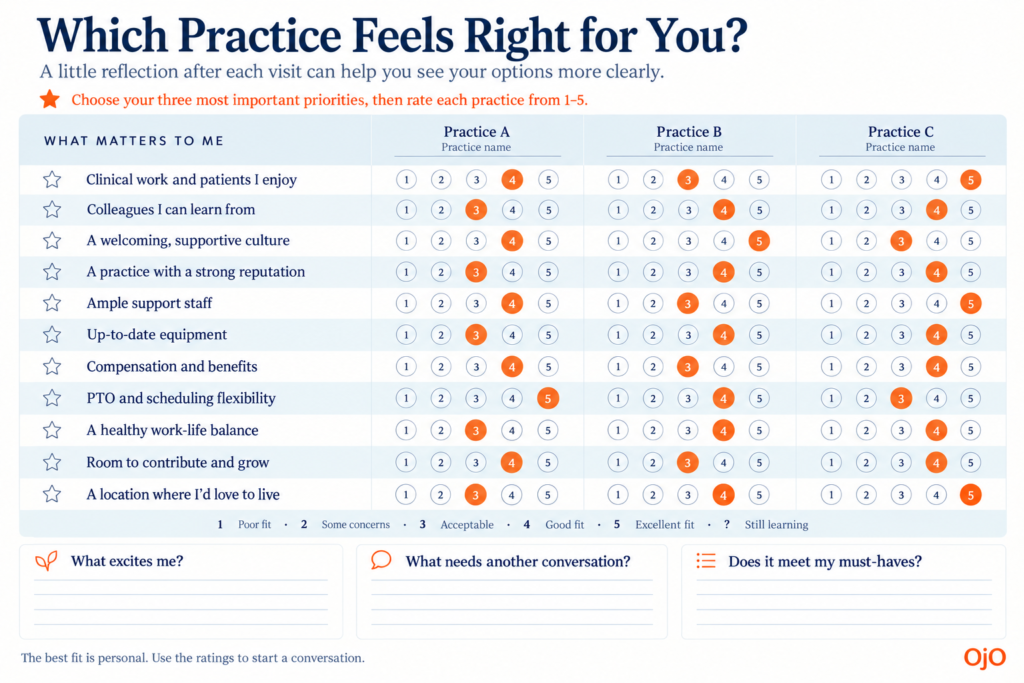
Write down your priorities before comparing positions. Which needs are essential? Where could you be flexible? What would you be willing to learn or build?
Think about the parts of residency you most enjoyed, then picture a normal week in each job. Would you like the patients and the pace? Could you ask questions comfortably? Would the schedule leave room for your family and interests?
Talk with mentors and doctors whose careers you admire. Ask what they learned from their first jobs and what they would look at more carefully today.
Your first position does not have to answer every question about your future. Look for work you are passionate about, people you want to collaborate with, and a place where you can build a life you enjoy.
If you’d like to talk through Medical Optometry jobs for Residency Trained ODs, reach out.
There’s a lot to look forward to as you take this next step in your career, and you don’t have to figure it all out on your own.
We’ve helped countless optometrists navigate this stage of their careers, and we’re happy to share what we’ve learned with residency-trained ODs as they consider where they’d like to grow, contribute, and build their future.
We’d love to hear what you’re hoping for—the patients you’d enjoy caring for, the colleagues you’d like to learn from, and the life you want to build. Whether you have a particular question or simply want to talk through the possibilities, reach out to our OjO team. We’re here to listen and help you think through what the right opportunity could look like for you. Your conversation with us is confidential, and our services are always free for job-seeking doctors.
You can also explore current opportunities through the Job Center on OjO’s website or reach out to us at info@ojorecruiting.com
Additional Resources for ODs from OjO
OD Compensation 2026: Salary, Bonuses, PTO & What We Typically See
How to Find the Right Optometry Job (Not Just Any Job). AKA “Cheez-Its & Choices.”
Your First Optometry Job: Insightful Guidance for New ODs Entering the Profession
5 Questions Every Optometrist in Training Should Ask Before Accepting a First Job Offer
Why More Ophthalmology Practices Are Hiring Medical Optometrists
How to Discuss Compensation During the Interview Process
Further reading from Outside Sources
- Association of Schools and Colleges of Optometry: Residency Programs
- VA Optometry: Education and Training
- American Optometric Association: Destination—Scope Expansion. For current procedural permissions and qualifications, check the relevant state optometry board.
About the Authors
Drew Caldwell founded OjO Recruitment Agency in 2009. He and the OjO team work with optometrists, ophthalmologists, and practices across the country, helping doctors think through job opportunities, practice relationships, and their long-term goals. This guide draws on those conversations and recruiting experience.
Dr. Gabrielle Anderson is a Reno native and optometrist who graduated from the Kentucky College of Optometry in 2025 and completed her residency at Vance Thompson Vision in Sioux Falls, South Dakota, specializing in advanced cornea and glaucoma management. She is a Fellow of the American Academy of Optometry (FAAO), reflecting her commitment to professional excellence and continued advancement in the field. Throughout her education and clinical training, Dr. Anderson demonstrated a strong commitment to academic achievement and leadership, serving as Chancellor of the Beta Sigma Kappa International Optometric Honor Society and President of the Cornea Contact Lens Society. Her clinical experience includes comprehensive eye care, ocular disease management, specialty contact lenses, and the co-management of patients undergoing advanced ophthalmic surgeries. She has also contributed to clinical research, professional publications, and presentations focused on ocular health. Having navigated the transition from optometry school through residency and into professional practice, Dr. Anderson is passionate about helping aspiring and newly graduated optometrists explore career opportunities and make informed decisions about their professional futures. Inspired by her great-grandmother’s experience with vision loss due to retinitis pigmentosa, Dr. Anderson is dedicated to providing patient-centered care and improving access to quality eye care for underserved populations, particularly in her home community of Reno, Nevada.